
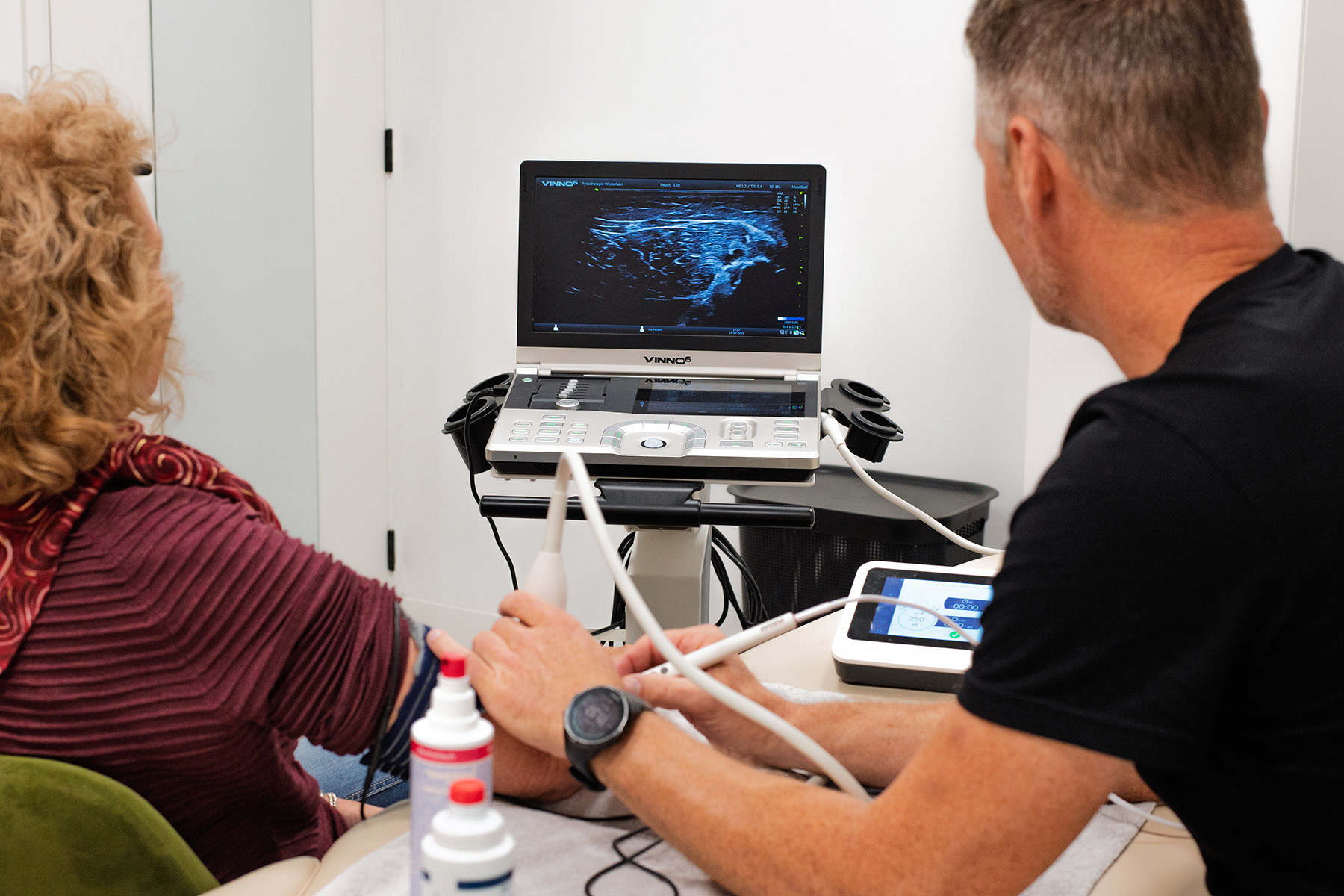
Percutaneous electrolysis (EPTE) is an innovative treatment method for long-term, poorly repairing tendon complaints.
The therapy is frequently and successfully used for moderate and poorly recovering injuries. In recent years, many physiotherapists have been trained to become percutaneous electrolysis specialists.
The treatment is intended to break the vicious circle of pain and is always supported with a special training program to make your muscles and tendons stronger, healthier and more resilient again.
How does the treatment work?
Contact gel is applied to the treatment area. With the help of ultrasound, the therapist can accurately see the correct location to insert the thin needle. You can usually watch the ultrasound image.
The skin is first disinfected before pricking. Then a very light electric current is administered for 1-2 minutes with the help of the electrolysis device. This triggers a number of “body’s own” physiological responses that promote recovery.
The pricking can be slightly sensitive. The treatment itself is usually not experienced as painful, sometimes it is short-term ‘uncomfortable’.
The treatment is always combined with exercises to promote the load capacity and natural recovery of the tendon.
Percutaneous electrolysis helps with the following complaints;
- Pain just below the kneecap at the patellar tendon (jumper’s knee)
- Pain in the Achilles tendon (achillodyne)
- Chronic elbow pain (tennis elbow)
- Chronic shoulder pain (supraspinatus tendon)
- Heel spur (plantar fasciopathy)
Advantages of percutaneous electrolysis
- Treatment without drugs or surgery
- Precise treatment under ultrasound control, directly at the location of the injury
- Short-term treatment of 1-2 minutes per session. After that, there are little to no restrictions on your normal daily activities.
- The treatment is virtually pain-free
- After 4 to 6 treatments, patients in most cases already report a clear reduction in pain or even a completely pain-free recovery.
- Few side effects. Sometimes the patient experiences a sore feeling for 1-2 days, this is a normal after-reaction. There are no other known negative side effects.


